Benchmarks' First Exam 13 Levels of AI Benchmarks
Benchmark Radar · k@benchmark-radar.org
Abstract
New benchmark papers promise to measure research, self-improvement and discovery, yet no study has placed the stream of new benchmarks on one scale. We place every record that Benchmark Radar collected from July to November 2026 on Benchmarks' First Exam (BFE 1.0), a thirteen-level scale (L0 to L12) ordered by the difficulty of the ability a passing score requires, from retrieval to predicting any state of the world.
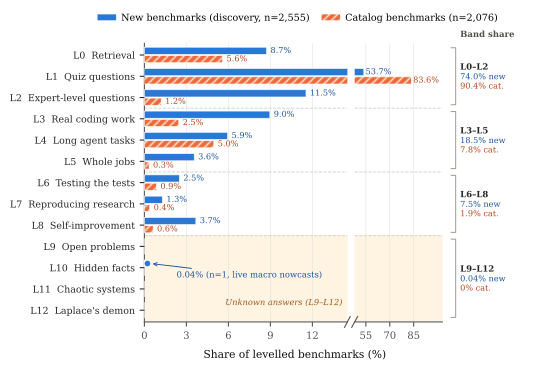
The census covers 33,735 records: 29,891 papers, repositories and datasets from 41 discovery sources, and 3,844 catalog benchmarks from six leaderboards and registries. A model labeller first decides whether each record introduces an AI benchmark, then assigns a level only when the text supports it. Only 1 of the 4,631 levelled benchmark records (4,525 after exact-identifier deduplication) asks a question whose answer nobody held when it was posed. Three in four levelled new benchmarks (74.0%) still score a single answer to a question, a share that did not fall from August to November.
A blind second labeller from a different model family relabelled a random sample of 1,500 records: it agrees on which records are benchmarks (κ = 0.78) and reproduces the level distribution, although it assigns a level to fewer records. Hard is not the same as unknown: the field keeps building harder exams for answers it already has.
Where New AI Benchmarks Sit
New benchmarks move beyond the leaderboard canon toward coding, long-horizon agent work, and research reproduction (18.5% at L3–L5 and 7.5% at L6–L8 vs. 7.8% and 1.9% in catalogs), but almost never cross into unknown answers (L9–L12).
Monthly stability across 11 continuous discovery sources
| Month (2026) | Records | Benchmarks | Levelled | L0–L2 (%) | L3–L5 (%) | L6–L8 (%) |
|---|---|---|---|---|---|---|
| August | 4,217 | 1,762 | 336 | 69 | 24 | 7 |
| September | 6,938 | 2,292 | 492 | 63 | 28 | 8 |
| October | 8,174 | 2,628 | 606 | 70 | 21 | 9 |
| November (through Nov 23) | 5,337 | 1,738 | 425 | 77 | 15 | 9 |
The 13 Levels of BFE 1.0
Before a benchmark examines an AI system, it sits an exam of its own: which ability does a passing score require? Labellers test levels from L12 down to L0 and assign the first level whose boundary test passes and whose evidence fields are complete.
| Level | Name | A passing score requires | Discovery | Catalog |
|---|---|---|---|---|
| Band 1: Single known answer (L0–L2) — 74.0% discovery · 90.4% catalog | ||||
| L0 | Retrieval | Returning information that exists in a source | 223 | 116 |
| L1 | Quiz questions | A short fixed answer a non-specialist can derive (MMLU, GSM8K) | 1,373 | 1,735 |
| L2 | Expert-level questions | A fixed answer that needs expertise (HLE, FrontierMath) | 295 | 25 |
| Band 2: Work in an environment (L3–L5) — 18.5% discovery · 7.8% catalog | ||||
| L3 | Real coding work | Code changes in a real project, judged by tests (SWE-bench) | 229 | 51 |
| L4 | Long agent tasks | Many actions toward one goal over a long horizon (OSWorld) | 152 | 103 |
| L5 | Whole jobs | A complete professional deliverable (GDPval) | 91 | 7 |
| Band 3: Known-outcome research and evaluation (L6–L8) — 7.5% discovery · 1.9% catalog | ||||
| L6 | Testing the tests | Judging whether a test, grader or result is valid | 64 | 18 |
| L7 | Reproducing research | A research result the evaluator holds (PaperBench) | 33 | 8 |
| L8 | Self-improvement | A measured improvement to an AI system (RE-Bench) | 94 | 13 |
| Band 4: Unknown answers (L9–L12) — 0.04% discovery · 0% catalog | ||||
| L9 | Open problems | A result nobody had when the benchmark was built | 0 | 0 |
| L10 | Hidden facts | A prediction scored when the world reveals it (ForecastBench; live macro nowcasts) | 1 | 0 |
| L11 | Chaotic systems | A prediction of a chaotic system, scored on later observations | 0 | 0 |
| L12 | Laplace's demon | A prediction of any state of the world (theoretical ceiling) | 0 | 0 |
| Levelled benchmark records (4,631 raw; 4,525 exact-identifier deduplicated) | 2,555 | 2,076 | ||
L9, L10, and L11 test three kinds of unknown answer and are not strictly ordered against each other. Missing evidence yields unclassified (7,106 discovery; 1,732 catalog); harnesses, leaderboards, and validity studies receive meta-evaluation (610 discovery; 30 catalog).
BFE 1.0 Rubric & Task Card
Use the boundary tests, 8 evidence fields, and task card below to place any AI benchmark on BFE 1.0.
Boundary tests (L0 → L1 through L11 → L12)
| Boundary | The higher level passes when |
|---|---|
| L0 → L1 | The answer is derived from information, not copied from a source. Search that returns a copied answer stays at L0. |
| L1 → L2 | The items need domain expertise, and experts wrote or checked them to be hard. Both levels score only a returned answer. |
| L2 → L3 | Running tests on code the system changed inside a real or realistic project decides the score. A standalone contest problem stays at L1 or L2. |
| L3 → L4 | The task takes many tool or environment actions toward one goal, over a long human-time horizon. Read-only browsing scored by its final answer stays at L1 or L2. |
| L4 → L5 | The task comes from real paid work, and the complete deliverable is judged at professional quality. |
| L5 → L6 | The score depends on the system correctly judging a test, a grader, or a claimed result as valid or invalid. |
| L6 → L7 | The score is a research result that the evaluator already holds. Replication names the target; rediscovery hides it. A closed question with one fixed answer stays at L1 or L2. |
| L7 → L8 | The score measures an improvement to an AI system over a stated baseline, such as a faster kernel or a lower training loss. Reproducing an ML paper without such an improvement stays at L7. |
| L8 → L9–L11 | Nobody holds the answer at the run-start cutoff. L9 scores a created result and needs a novelty check; L10 scores a prediction the world later resolves; L11 scores a chaotic-system prediction against later observations. Retrospective forecasts scored against pre-cutoff data (e.g., WeatherBench 2 for 2020) stay below L9. |
| L11 → L12 | The task predicts any state of the world. No finite benchmark passes. |
Required evidence fields (1–6 for L0–L12; 7–8 additionally for L9–L11)
| # | Field | Required for | Definition |
|---|---|---|---|
| 1 | Scored outcome | L0–L12 | The state or result that decides pass or fail. |
| 2 | Agent-visible target | L0–L12 | The goal, finding, or protocol given to the agent. |
| 3 | Evaluator knowledge | L0–L12 | What the evaluator knew before the run. |
| 4 | Verifier modality | L0–L12 | Exact, executable, simulation, model judge, human expert, or hybrid. |
| 5 | Verifier procedure | L0–L12 | The checks, equivalence criteria, and evidence link. |
| 6 | Level rationale | L0–L12 | One sentence naming the requirement that sets the level. |
| 7 | Evaluation cutoff | L9–L11 | The run-start timestamp showing the answer was unknown. |
| 8 | Novelty check / resolution | L9–L11 | For L9: prior-art scope, sources, search dates, and domain-expert attestation. For L10–L11: the event that revealed the answer and its date. |
BFE 1.0 task card schema & descriptive tags
TASK: <id>
BFE VERSION: 1.0
LEVEL: L0 / L1 / ... / L12 / meta-evaluation / unclassified

SCORED OUTCOME: <what decides pass or fail>
AGENT-VISIBLE TARGET: <what the agent receives>
EVALUATOR KNOWLEDGE: <what was known before the run>
EVALUATION CUTOFF: <run-start timestamp; required for L9 to L11>
NOVELTY CHECK OR RESOLUTION EVENT: <required for L9 to L11>
VERIFIER MODALITY: <exact, executable, simulation, model judge, human expert, or hybrid>
VERIFIER PROCEDURE: <checks, equivalence criteria, and evidence link>
LEVEL RATIONALE: <one sentence>

TAGS
  horizon:     single-turn | multi-turn | cross-session | streaming | lifelong
  state:       stateless | workspace | memory | persistent learning state
  interaction: text | tools | browser | desktop | code | embodied | multi-agent
  evaluation:  exact | executable | simulation | model judge | human expert
  risk:        privacy | security | policy compliance | destructive action
  resources:   latency | cost | compute | memory | network

SLIM ASSESSMENT: <link or pending>
CLASSIFIED BY: <name>
DATE: <date>
Citation
BibTeX entry (Concept DOI 10.5281/zenodo.24616507 resolves to the latest version; v1.0.0 is 10.5281/zenodo.24643984):
@misc{wu2026bfe,
  title     = {Benchmarks' First Exam: 13 Levels of AI Benchmarks},
  author    = {Wu, Koutian},
  year      = {2026},
  publisher = {Zenodo},
  doi       = {10.5281/zenodo.24616507},
  url       = {https://benchmarkfirstexam.com}
}